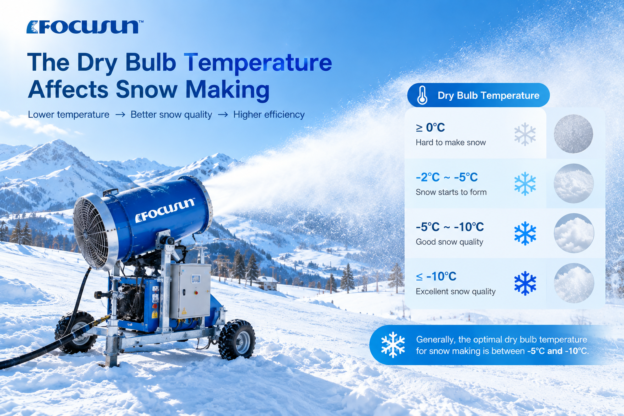
A snow cannon, also called a snow gun, produces snow by spraying fine water droplets into cold outdoor air. An indoor snow machine creates snow in a more controlled environment, usually with integrated refrigeration or a dedicated indoor cooling system.
The two technologies can serve different project needs. The right choice depends on weather conditions, venue type, required snow output, snow quality and available infrastructure.
What Is a Snow Cannon?
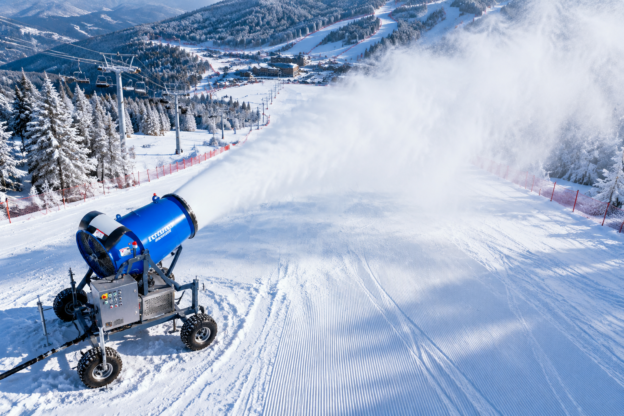
A snow cannon — also known as a snow gun or fan snow gun — is the equipment most people picture when they think of snowmaking. It’s used mainly at outdoor ski resorts and snow parks, where it sprays atomized water into the surrounding air and relies on that air’s temperature and humidity to freeze the droplets before they land.
Depending on the design, a snow cannon may use compressed air, a fan, or a combination of both to break water into fine droplets and project them over distance.
More details: https://www.snowparkbuild.com/products/fan-snow-cannon-machine.html
How Does a Snow Cannon Work?
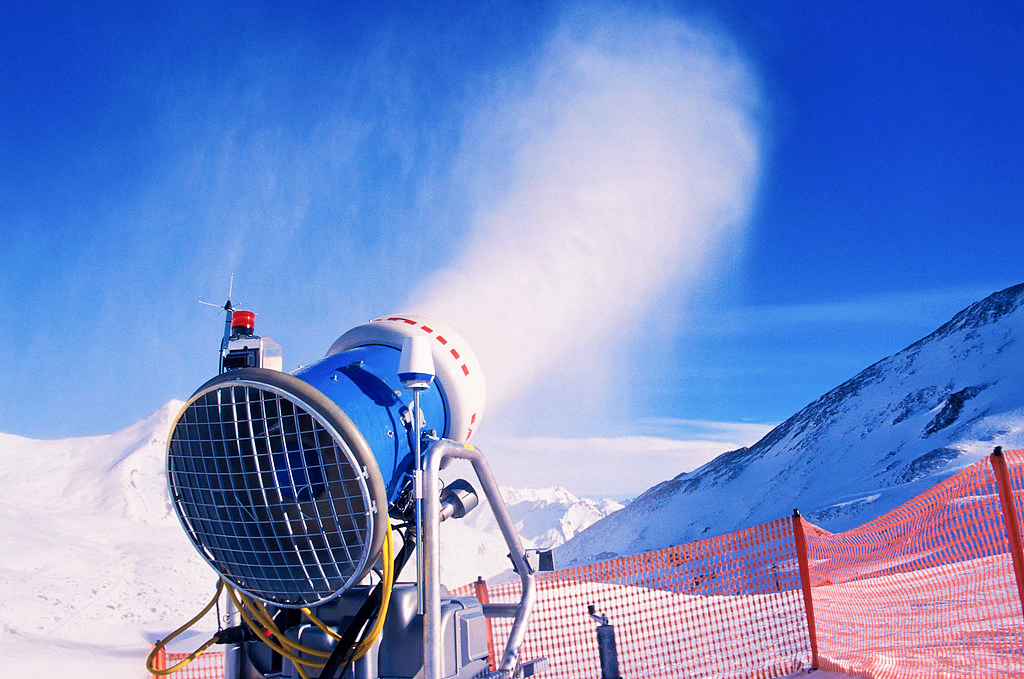
The process happens in four steps:
- Water is pumped to the snow cannon.
- Nozzles break the water into fine droplets.
- Nucleation helps ice crystals begin to form.
- The droplets freeze while traveling through cold air.
The final result depends on a combination of factors — wet-bulb temperature, water temperature, pressure, nozzle design, wind, and throw distance all play a role in how much snow comes out, and how good it is.
More details: https://www.snowparkbuild.com/how-does-snowmaking-work-process-temperature-and-equipment.html
What Is an Indoor Snow Machine?
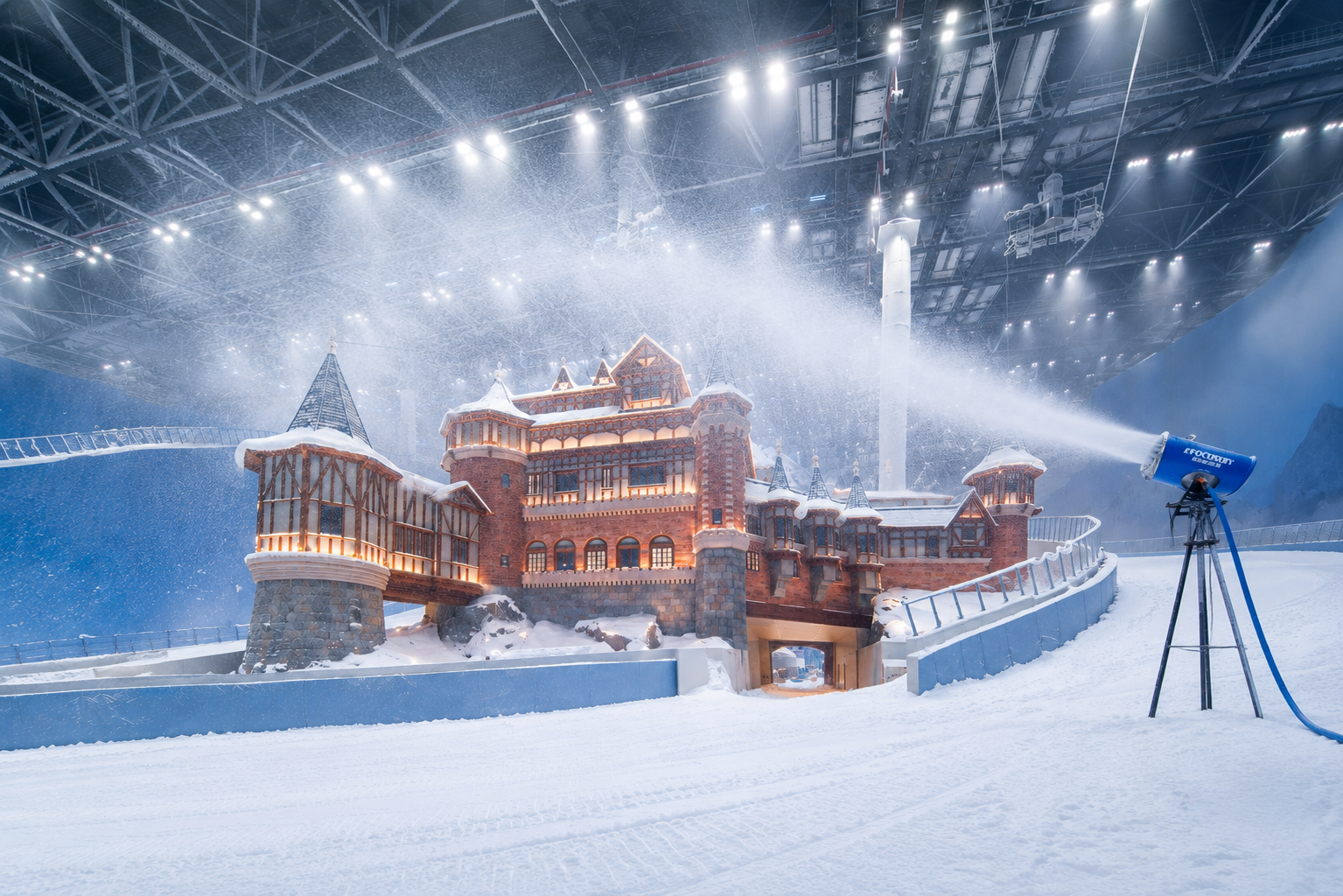
“Indoor snow machine” can refer to several different equipment types, so it’s worth being specific about what the term covers here. In this context, it describes a machine or system that produces snow inside a controlled indoor facility, typically built around:
- Integrated or connected refrigeration
- Controlled air temperature and humidity
- Water supply and filtration
- Snow discharge or distribution equipment
- Controls for continuous or scheduled operation
Some indoor systems are designed for permanent snow parks that run year-round. Others are compact units built for snow-play areas, events, or temporary installations that only need to operate for a limited window.
More details: https://www.snowparkbuild.com/products/indoor-mobile-snow-machine.html
Snow Cannon vs Indoor Snow Machine: Key Differences
| Factor |
Snow Cannon |
Indoor Snow Machine |
| Main freezing method |
Cold outdoor air |
Controlled refrigeration or indoor cooling |
| Weather dependence |
High |
Lower |
| Typical location |
Outdoor slopes and snow parks |
Indoor snow parks, ski slopes and attractions |
| Operating window |
Seasonal or weather-limited |
Can support scheduled or year-round operation |
| Main design priority |
Throw distance and slope coverage |
Controlled snow production and indoor integration |
| Supporting systems |
Water, power, air, weather monitoring |
Water, power, refrigeration, ventilation, drainage |
| Common project scale |
Outdoor resort areas |
Indoor venues and controlled snow zones |
| Key planning issue |
Wet-bulb conditions |
Building systems and energy use |
Neither technology is universally better — each is built to solve a different set of constraints.
Snow Cannon vs Indoor Snow Machine: Snow Quality and Output
Snow cannon
- Snow quality changes with weather conditions.
- Output may vary during the day as wet-bulb conditions shift.
- Well suited to building a durable outdoor base.
- Multiple units can cover large areas efficiently.
Indoor snow machine
- Snow production can be more consistent, since it isn’t waiting on outdoor weather.
- Snow quality can be managed through indoor conditions.
- The final result depends on refrigeration, humidity, air movement and grooming.
- Capacity must be matched carefully to venue size and expected visitor use.
Indoor snow isn’t automatically lighter, and snow cannons don’t automatically produce denser snow — the actual result comes down to the specific equipment and how the system is operated, not the category it falls into.
Can a Snow Cannon Be Used Indoors?
Not automatically. A conventional snow cannon isn’t built with the assumption that it’ll operate inside a building, and its performance indoors depends heavily on air-movement, humidity, temperature, drainage, noise, throw distance and the building’s own cooling capacity.
Some snow guns can be adapted for indoor use, but that adaptation has to be evaluated as part of the complete venue system — not treated as a simple swap. A standard outdoor snow cannon shouldn’t be presented as a direct substitute for a purpose-built indoor snowmaking solution.
Can an Indoor Snow Machine Be Used Outdoors?
Some all-weather or containerized snowmaking systems can operate in outdoor, warm-climate projects. But moving outdoors still requires planning around:
- Snow delivery distance
- Ventilation and heat rejection
- Water and power supply
- Weather exposure
- Snow storage and surface management
- Equipment protection and maintenance access
Whether a specific model can actually handle outdoor conditions needs to be confirmed against its technical data — not assumed from the “all-weather” label alone.
Which One Should a Project Choose?
The right choice comes down to project type, not brand preference.
A snow cannon may be suitable when:
- The project is an outdoor ski slope or snow park.
- Seasonal cold weather is available.
- Large-area snow coverage is required.
- The site can support pipelines, pumps and weather monitoring.
An indoor snow machine may be suitable when:
- The project operates inside a building.
- Snow is required in a warm or tropical climate.
- Production needs to run on a schedule, independent of weather.
- The venue can support refrigeration, ventilation, drainage and humidity control.
An all-weather system may be considered when:
- The project is outdoors but weather conditions are unreliable.
- The site needs snow production in warm conditions.
- A containerized or centralized system fits the project layout.
Internal link: [What Is All-Weather Snowmaking?]
What Should Buyers Check Before Selecting Equipment?
Before comparing specific models, it helps to have clear answers to:
- Required snow output per day and at peak times
- Target snow quality and intended use
- Local air temperature and wet-bulb data
- Indoor or outdoor operating conditions
- Water quality, pressure and treatment
- Power supply and refrigeration requirements
- Snow distribution distance
- Space for installation and maintenance
- Drainage and meltwater management
- Energy consumption and operating hours
- Spare parts, commissioning and after-sales service
More details: https://www.snowparkbuild.com/how-does-snowmaking-work-process-temperature-and-equipment.html
Frequently Asked Questions
Is a snow cannon the same as a snow gun?
In most industry contexts, yes. “Snow cannon” and “snow gun” are commonly used for outdoor snowmaking equipment, although naming may vary by region.
Can a snow cannon make snow above freezing?
Its performance depends on wet-bulb temperature and the specific system. When conditions are too warm or humid, output and snow quality usually decline.
Is an indoor snow machine the same as an all-weather snowmaker?
Not always. An indoor snow machine is defined by its application or installation environment, while an all-weather snowmaker is defined by its ability to operate with less dependence on outdoor weather.
Which produces better snow?
Neither is automatically better. The suitable technology depends on climate, venue, required output, snow quality and the complete project system.
Related Resources

 10-14-2026