How do all-weather snowmaking machines work in hot climates?
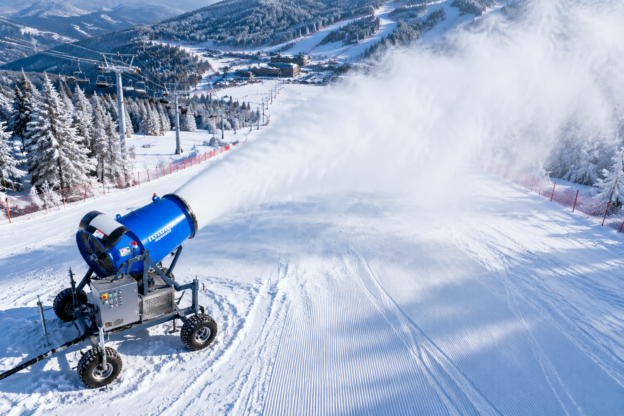
All-weather snowmaking machines produce snow independently of outdoor freezing temperatures by freezing water inside a refrigerated system, crushing the resulting ice into snow-like particles, and conveying the snow to the target area. Unlike conventional snow guns, they do not rely on cold outdoor air to freeze water droplets. Their practical performance depends on refrigeration capacity, ambient temperature, water temperature, energy consumption, and snowmelt conditions.
Snow on a 35 °C afternoon used to be a problem you solved with a roof. Indoor ski halls in hot regions have proved the point for years, but a roof is expensive, and plenty of operators would rather build an outdoor or semi-open snow attraction if the snow itself could be trusted. That is the job of the all-weather snow machine.
The principle is easy to state. A conventional snow gun needs cold, dry air to freeze water droplets in flight. An
all-weather snowmaking machine moves the freezing step inside a refrigerated plant, makes ice there, turns the ice into snow and delivers it to the site. Snowmaking above freezing stops being a contradiction and becomes a question of refrigeration capacity, power, water and site planning. This article covers how the technology works, where it fits and what buyers should check before they sign.
Why Traditional Snowmaking Is Limited by Weather
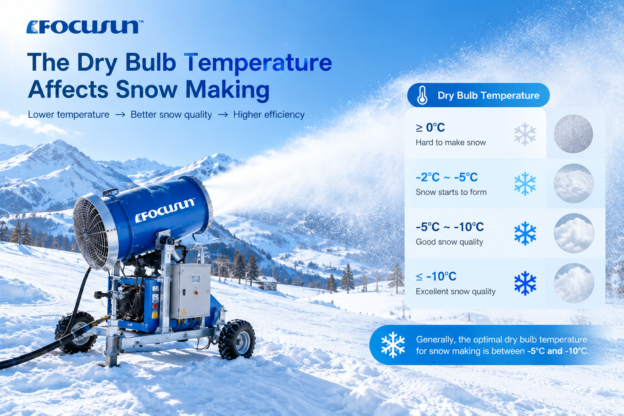
A snow gun throws a cloud of fine droplets into open air and relies on that air to freeze them before they land. How well this works depends on wet-bulb temperature, a single number that combines air temperature and humidity. Snowmaking systems generally need a wet-bulb temperature of around −2.5 °C to start, and drier air lowers the wet-bulb reading for a given air temperature. Guns can keep producing up to roughly −1 °C wet-bulb.
Humidity can make or break a night. Air at 0 °C with 90% humidity has a wet-bulb temperature of about −0.6 °C, while the same temperature at 30% humidity gives about −4.3 °C. The first is above what a gun can handle, and the second is productive. At +10 °C, even very dry air stays above the working range, so a snow gun has nothing to work with.
For operators in warm or marginal climates this means a short, unpredictable window. Production has to be squeezed into the few cold nights available, the base gets built late, and one warm spell can undo weeks of work. Attractions that sell tickets on a fixed calendar can’t plan around that, and neither can training programs that need a dependable surface.
What Is an All-Weather Snowmaking Machine?
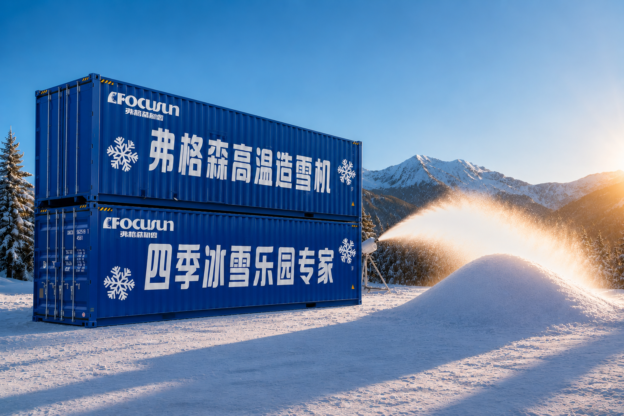
An all-weather snowmaking machine is a refrigeration-based system that makes snow independently of outdoor air conditions. You will see the same equipment sold as an all-weather snow machine, a
high-temperature snowmaking machine, or a snow making machine for warm climates. The names differ, but the logic is the same: the snow is made in a refrigerated chamber and pushed out through tubes, so it forms in the cold before it meets warm outdoor air.
The physics is straightforward. Turning water into ice means removing about 334 kJ of latent heat per kilogram, and a refrigeration plant does that whatever the weather outside. What the outdoor temperature changes is how hard the plant has to work to reject that heat, which is why capacity and power draw matter so much in hot regions.
|
Conventional snow gun |
All-weather snowmaking machine |
| Where water freezes |
In the air, after the nozzle |
Inside the refrigeration plant |
| What it depends on |
Cold, dry air (low wet-bulb) |
Refrigeration capacity, power and water |
| Operating window |
Limited to cold nights |
Largely independent of ambient temperature, within design limits |
| Snow character |
Varies with the weather |
Consistent, made from crushed ice |
| Energy use |
Low when conditions are right |
Higher, because the ice is made by refrigeration |
| Typical role |
Primary snowmaking in cold climates |
Warm climates, marginal seasons and top-ups |
Five functions make up the chain, and each one has a design consequence in hot weather.
Refrigeration System
The refrigeration plant removes the heat that turns water into ice, then has to reject that heat to the surroundings. In a hot climate the rejection side is the hard part: the warmer the air, the more work per kilogram of ice. Focusun’s smaller models run on R507 or R449A, while the largest, MiddleSnow, uses ammonia (R717). The effect shows up in the rated energy figures: 35 kWh per cubic meter of snow on the first four models and 20 kWh/m³ on MiddleSnow. Ammonia brings its own safety and permitting requirements, so it tends to suit larger sites with good technical support.
Ice Production
Inside the container, water is frozen into ice continuously. The feed water matters more than most buyers expect. The rated range is 2–22 °C, with 10 °C as the design point, so a warm supply means more cooling load before any ice forms. Check your incoming water temperature against that range early.
Ice Crushing
The ice is then crushed into fine, snow-like grains. Grain size and handling decide how the snow feels underfoot and how fast it settles. The rated outputs imply a density of about 445–455 kg/m³, which is close to conventional machine-made snow and well above natural powder.
Snow Conveying
The snow leaves the container projected over a rated throw distance: 20–50 m on the 20-foot EastSnow, 50–70 m on WestSnow, 50–80 m on SouthSnow and 50–100 m on NorthSnow and MiddleSnow. Throw distance sets the practical footprint around the plant, so the position of the container is a design decision from day one.
PLC Control System
A PLC coordinates start-up, compressor loading, safety interlocks and alarms. On an attraction that runs every day, automatic control keeps staffing low and output predictable. Ask what the controller logs and whether remote monitoring is available.
Key Applications in Warm Climate Regions
A snow making machine for warm climates earns its keep wherever the snow has a commercial job and the weather refuses to cooperate.
Outdoor Snow Parks
Outdoor snow park snowmaking is the hardest case, because heat works against the snow all day. A rough planning calculation shows the scale. Machine-made snow from conventional guns is commonly around 450 kg/m³ or denser, against 80–150 kg/m³ for natural dendritic snow. A 30 cm layer at 450 kg/m³ holds about 135 kg of snow per square meter. Snowmelt models typically use 3–6 mm of water equivalent per °C per day. At a mean of +10 °C that is 30–60 kg per square meter lost each day, so an unshaded 30 cm layer lasts roughly 2.3 to 4.5 days without top-ups. Treat that as planning arithmetic, not a guarantee. Shade, wind protection and compact layouts all stretch the number.
Commercial Winter Attractions
Theme parks, shopping destinations and resorts add snow zones to offer something heat cannot take away. These sites usually need moderate depth, steady daily replenishment and a surface that looks the same in July as it does in January.
Seasonal Entertainment Projects
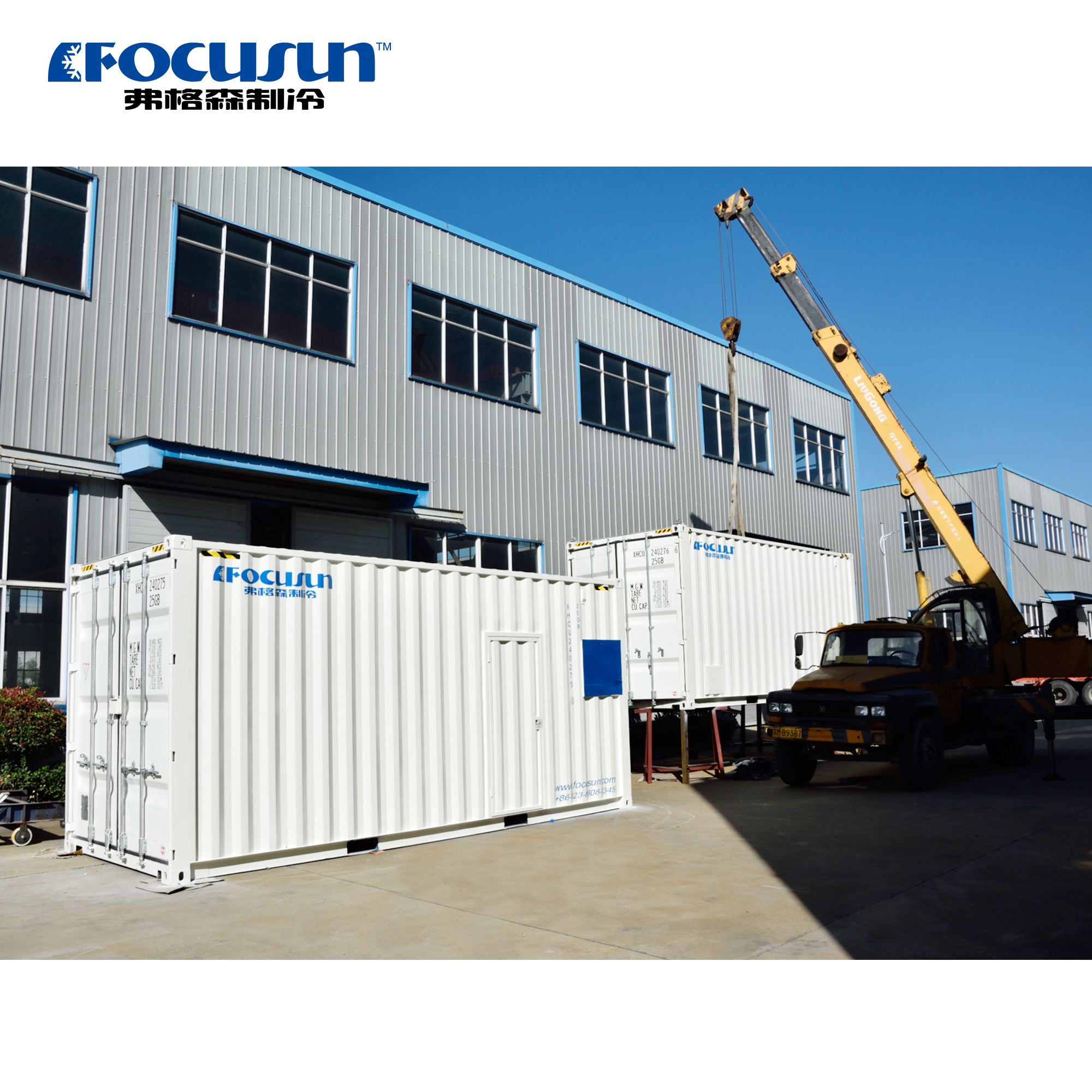
Winter festivals, holiday events and promotional installations run for weeks, not years. A self-contained, containerized plant limits site work to foundation, power, water and drainage, which suits projects with a fixed calendar.
Ski Training and Snow Play Areas
Short learning slopes, snowboard training areas and children’s play zones need little area but a predictable surface. A compact footprint is easier to cover thickly and easier to protect from the sun.
What Should Buyers Consider Before Investing?
The same questions come up on almost every project. Ask the supplier for numbers at your design conditions, not at the best case on the brochure.
| Factor |
Why it matters |
What to ask the supplier |
| Daily snow production capacity |
Sets how much surface you can keep covered |
Snow output in m³ and tonnes per day at your air and water temperature |
| Ambient temperature |
Hot air raises the cost of rejecting heat, lowering output and raising power use |
Output at your peak ambient, not only at the design point |
| Electricity consumption |
Ice making is the dominant load |
Rated power, kWh per m³ and the power supply you need |
| Water consumption |
Roughly one liter per kilogram of snow |
Flow rate, pressure and feed water temperature limits |
| Site requirements |
Foundation, utilities, drainage and access all affect cost |
Container footprint, weight, crane access and throw distance |
| Snow quality |
Density and grain size affect feel and how long snow lasts |
Sample and density at your configuration |
| Maintenance and installation |
Downtime in a ticketed season costs money |
Service schedule, spare parts, commissioning and training |
Capacity is where projects most often go wrong, so run the numbers early. At the losses above, an unshaded 2,000 m² area at +10 °C needs 60–120 tonnes of snow a day just to hold its depth, which is the territory of the larger models. The table below turns the same arithmetic around and shows how much unshaded surface each model could keep topped up.
| Model |
Rated output |
Indicative area kept topped up |
| EastSnow |
30 t/day |
about 500–1,000 m² |
| WestSnow |
45 t/day |
about 750–1,500 m² |
| SouthSnow |
80 t/day |
about 1,300–2,700 m² |
| NorthSnow |
120 t/day |
about 2,000–4,000 m² |
| MiddleSnow |
160 t/day |
about 2,700–5,300 m² |
Assumes 30–60 kg/m² lost per day at +10 °C mean temperature, no shade, and no allowance for grooming or visitor traffic. Output falls as air and water temperatures rise, so confirm figures for your site.
Shade, covers and enclosed spaces cut the losses and stretch every number in that table.
FOCUSUN’s Containerized All-Weather Snowmaking Solution
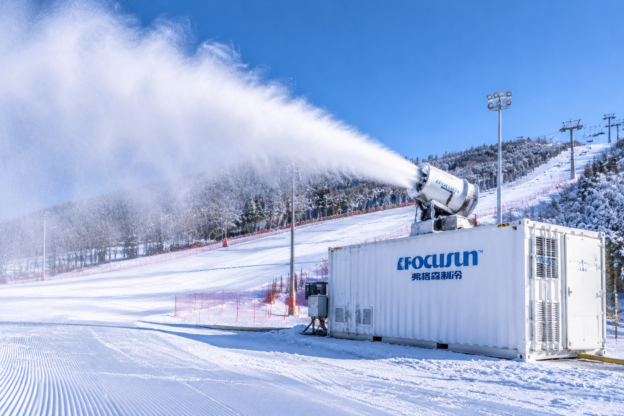
Focusun is a Shanghai-based manufacturer of ice machines and refrigeration equipment. Its All-Weather Snow System is engineered for tropical and high-temperature regions and aims for stable production of fluffy snow in hot environments. The range is a containerized snowmaking system built in five sizes.
iaapa
An Integrated Containerized Snowmaking System in Five Sizes
| Model |
Containers |
Snow output |
Throw distance |
Rated power |
Energy use |
Refrigerant |
Weight |
| EastSnow |
1 × 20 ft |
66 m³ / 30 t per day |
20–50 m |
96 kW |
35 kWh/m³ |
R507 / R449A |
10,500 kg |
| WestSnow |
1 × 40 ft HC |
100 m³ / 45 t per day |
50–70 m |
140 kW |
35 kWh/m³ |
R507 / R449A |
17,500 kg |
| SouthSnow |
2 × 40 ft HC |
180 m³ / 80 t per day |
50–80 m |
254 kW |
35 kWh/m³ |
R507 / R449A |
22,000 kg |
| NorthSnow |
2 × 40 ft HC |
270 m³ / 120 t per day |
50–100 m |
360 kW (R449A) |
35 kWh/m³ |
R507 / R449A / R717 |
30,000 kg |
| MiddleSnow |
2 × 40 ft HC |
352 m³ / 160 t per day |
50–100 m |
287 kW |
20 kWh/m³ |
R717 |
33,600 kg |
Output is quoted at the design point of 20 °C ambient air and 10 °C feed water.
To make the figures concrete: EastSnow at full output draws about 2,300 kWh a day (66 m³ at 35 kWh/m³) and about 1,250 liters of water an hour, at roughly a liter per kilogram of snow.
Operating Range and Site Connections
All five models share the same operating envelope. They are rated for ambient air from −25 °C to +36 °C and feed water from 2 °C to 22 °C. The design point sits at 20 °C air and 10 °C water, which is why output at the top of the range needs to be confirmed for your site.
The site requirements are modest compared with a building. Power is 400 V, three-phase, 50 Hz. Water arrives through a 3/4″ connection on EastSnow and WestSnow and a 1-1/4″ connection on the larger models, at 2–5 bar. The containers measure 6 m × 2.4 m × 2.4 m for the 20-footer and 12 m × 2.4 m × 2.9 m for each 40-foot high cube, so transport, crane access and a level hard standing are the main civil items.
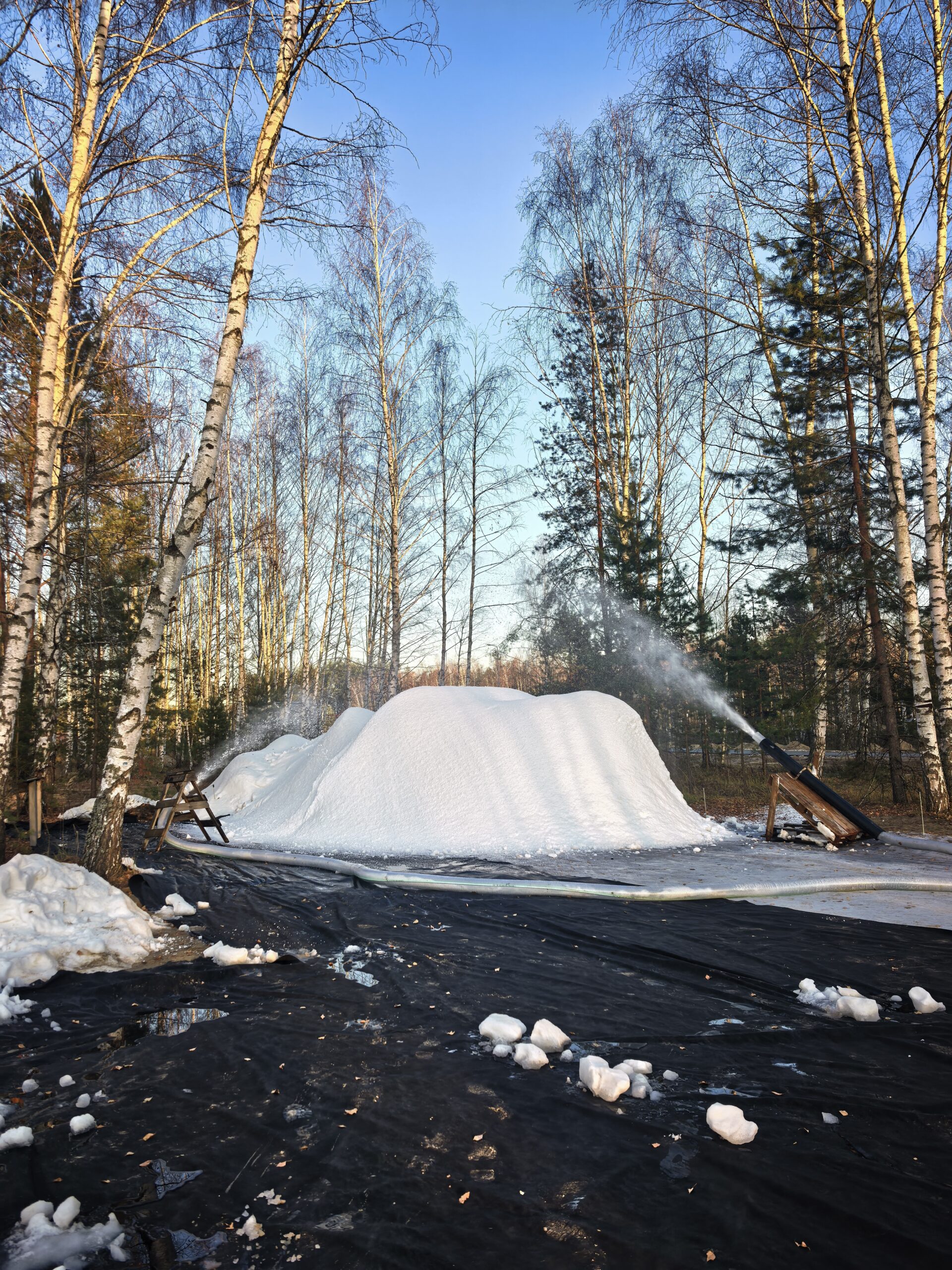
See the FOCUSUN Snow Making Machine in Operation
Please check
the operating video. Full specifications and configuration options are on the official product page: https://www.snowparkbuild.com/products/All-weather-snowmaking-system.html.
Real-World Application: All-Weather Snowmaking in Tropical Environments
Rated specifications show what a machine can do on paper. A site record shows what it does when the air is 35 °C, the feed water is warm and visitors are on the snow every day. The project below is documented the way a buyer would want to read it: site conditions first, then measured results against the rated figures.
| Item |
Project record |
Rated or design-basis figure (EastSnow) |
| Project and location |
Snow Carnival, Miami, United States |
n/a |
| Site climate |
Mean peak summer temperature, humidity range and operating season, from local climate records |
Rated ambient range −25 °C to +36 °C |
| Application |
Outdoor snow park; area in 20000 m²; target depth 30 cm; |
n/a |
| Model and configuration |
EastSnow; 1 unit; R507 |
1 × 20 ft container; 6 m × 2.4 m × 2.4 m; 10,500 kg |
| Feed water |
Supply temperature and pressure |
2–22 °C at 2–5 bar; 3/4″ connection |
| Measured daily output |
m³ and tonnes per day at site conditions |
66 m³ / 30 t per day at 20 °C air and 10 °C water; throw 20–50 m |
| Measured energy use |
kWh per m³ at site conditions |
35 kWh/m³; 96 kW rated; about 2,300 kWh per day at full output |
| Snow performance |
Density in kg/m³, hours the snow stayed usable, daily top-up volume |
About 455 kg/m³ implied by the rated output |
| Operation |
Daily running hours, staffing, downtime since commissioning |
400 V, three-phase, 50 Hz |
What the rating means for this site. At full output EastSnow delivers 66 m³, about 30 tonnes, of snow a day. Under the planning losses used earlier in this article (30–60 kg per square meter per day at a +10 °C mean, unshaded), that keeps roughly 500–1,000 m² topped up. Cover and shade lower the losses and stretch the area. Building a 30 cm base takes about 4.5 days of full output for every 1,000 m², so the footprint of the park sets both the build-up time and the daily top-up. Output at the top of the temperature range is lower than the design-point figure, which is why the measured row above matters.
Frequently Asked Questions
Can snow machines work above 0 °C?
Conventional guns can’t, because they stop producing once the wet-bulb temperature climbs past roughly −1 °C. An all-weather machine makes ice inside a refrigeration plant, so it can work above 0 °C. Focusun’s units are rated for ambient air up to +36 °C. The snow still melts quickly outdoors, so the layer needs regular top-ups.
How does an all-weather snowmaking system work?
Refrigeration freezes water into ice inside the container, a crusher turns the ice into snow and the snow is projected onto the site over a rated throw distance. A PLC coordinates the compressors, safety interlocks and alarms.
Can artificial snow be produced in tropical climates?
Yes, with an ice-based system. Focusun’s models are rated from −25 °C to +36 °C ambient with feed water between 2 °C and 22 °C. The practical limits are capacity at your actual air and water temperature, power and water supply, and how fast the snow melts, which is why shade, compact layouts and daily replenishment matter.
What is the difference between ice-based snowmaking and conventional snow guns?
A snow gun freezes droplets in the air and needs cold, dry weather. An ice-based, all-weather machine freezes water inside a refrigeration plant, crushes the ice and delivers it as snow, so the weather only changes how hard the plant has to work. The trade-off is higher energy use (Focusun’s rated figures are 20–35 kWh per cubic meter of snow) and higher capital cost in exchange for independence from the weather. The two are complementary: guns suit cold climates and cold nights, while ice-based systems suit warm climates, marginal seasons and top-ups.
How much snow can an industrial snowmaking machine produce per day?
Across Focusun’s five models, rated output runs from 66 m³ (30 tonnes) per day on EastSnow to 352 m³ (160 tonnes) per day on MiddleSnow, quoted at 20 °C ambient air and 10 °C feed water. Output drops as air and water get warmer, so ask for the figure at your own conditions before sizing a project.
How long does machine-made snow last in warm weather?
At a mean of +10 °C, melt models point to roughly 30–60 mm of water equivalent per day, which gives an unshaded 30 cm layer about 2.3 to 4.5 days. Shade, wind protection and thicker layers extend that, and an enclosed space extends it much further.
How much electricity does an all-weather snowmaking machine consume per day?
At full rated output and the design point, daily consumption is rated output multiplied by energy use. That gives about 2,300 kWh a day for EastSnow (66 m³ × 35 kWh/m³), about 3,500 kWh for WestSnow, about 6,300 kWh for SouthSnow, about 9,500 kWh for NorthSnow and about 7,000 kWh for MiddleSnow (352 m³ × 20 kWh/m³). Hotter air and warmer feed water raise the energy per cubic meter and cut output, so ask for figures at your own site conditions. Few sites run at full output around the clock, so the real daily figure follows the production schedule.
How much does an industrial snowmaking machine cost?
There is no single price. Cost depends on production capacity, the refrigeration configuration and refrigerant, shipping and installation, and the supporting works around the machine: foundation, power supply, water supply, drainage and snow handling. A 30-tonne-a-day single-container unit and a 160-tonne-a-day two-container ammonia plant are different projects. Running cost is mostly electricity and water, so it is worth pricing those alongside the equipment. The most reliable way to get a number is to send the supplier your site, area, target depth and utility conditions and ask for a quotation against them.
What is the best snowmaking system for a tropical snow park?
The best system is the one sized for your daily snow loss, not your opening-day snow. Work out the area, the depth and the melt rate first, then choose the model whose rated output covers the daily top-up at your site’s air and water temperature. On the planning figures in this article, the five Focusun models cover roughly 500 m² (EastSnow) up to 5,300 m² (MiddleSnow) of unshaded surface at a +10 °C mean. Beyond capacity, check the refrigerant and permitting route, water supply, and whether throw distance suits your layout. Shade, wind protection and a compact layout reduce what the machine has to replace, and they often cost less than extra capacity.
How many tons of snow are needed for a 2,000 m² snow park?
Two numbers matter: the base and the daily top-up. A 30 cm layer at about 450 kg/m³ is roughly 135 kg per square meter, so 2,000 m² needs about 270 tonnes (600 m³) to build the base. Holding that depth at a +10 °C mean, with 30–60 kg/m² lost a day, takes a further 60–120 tonnes a day. For scale, and ignoring melt during the build, NorthSnow at 120 tonnes a day could lay the base in a little over two days of full output, while EastSnow at 30 tonnes a day would need about nine. Shade, a thinner layer or a lower daily mean temperature all reduce these numbers.
Can artificial snow survive at 35 °C?
The machine can; the snow struggles. Focusun’s units are rated for ambient air up to +36 °C, so they keep producing at 35 °C. Outdoors in full sun, though, the same planning melt model (3–6 mm of water equivalent per °C per day) stretched to a 35 °C mean gives losses of 105–210 kg per square meter per day, which would remove an unshaded 30 cm layer in roughly 0.6 to 1.3 days. Treat that as a crude upper bound, since degree-day models were not built for that range, but the direction is clear. Snow at 35 °C survives through continuous replenishment, shade, wind protection, thicker layers or a semi-enclosed space.
Planning a Snow Attraction in a Warm Climate?
Start with the site, not the machine. Send Focusun’s engineering team your location, area, target snow depth, operating season, and the temperature and supply of your water and power. They can propose the right model and configuration for it. [https://www.snowparkbuild.com/contact-us.html]
References
- Olefs, M., Fischer, A., & Lang, J. (2010). Boundary Conditions for Artificial Snow Production in the Austrian Alps. Journal of Applied Meteorology and Climatology, 49(6), 1096–1113.
https://doi.org/10.1175/2010JAMC2251.1
Supports: The role of wet-bulb temperature, air temperature and relative humidity in conventional snowmaking; the approximate wet-bulb temperature threshold for snow production.
- International Association of Amusement Parks and Attractions (IAAPA). Focusun – IAAPA Marketplace Supplier Profile.
https://iaapa.org/partners/marketplace/focusun-refrigeration-inc
Supports: Industry context for snowmaking and snow effects used in theme parks and live entertainment attractions.
- All-Weather Snow Making Machine – Product Specifications.
https://www.snowparkbuild.com/products/All-weather-snowmaking-system.html
Supports: Focusun product descriptions, model configurations, rated snow output, operating temperature range, power consumption, refrigerants, dimensions and site connection requirements. Manufacturer specifications should be identified as manufacturer-provided data.

 11-13-2026